🤖 Edge AI vs. Cloud AI: Where is the Future Headed?
🚀 Introduction
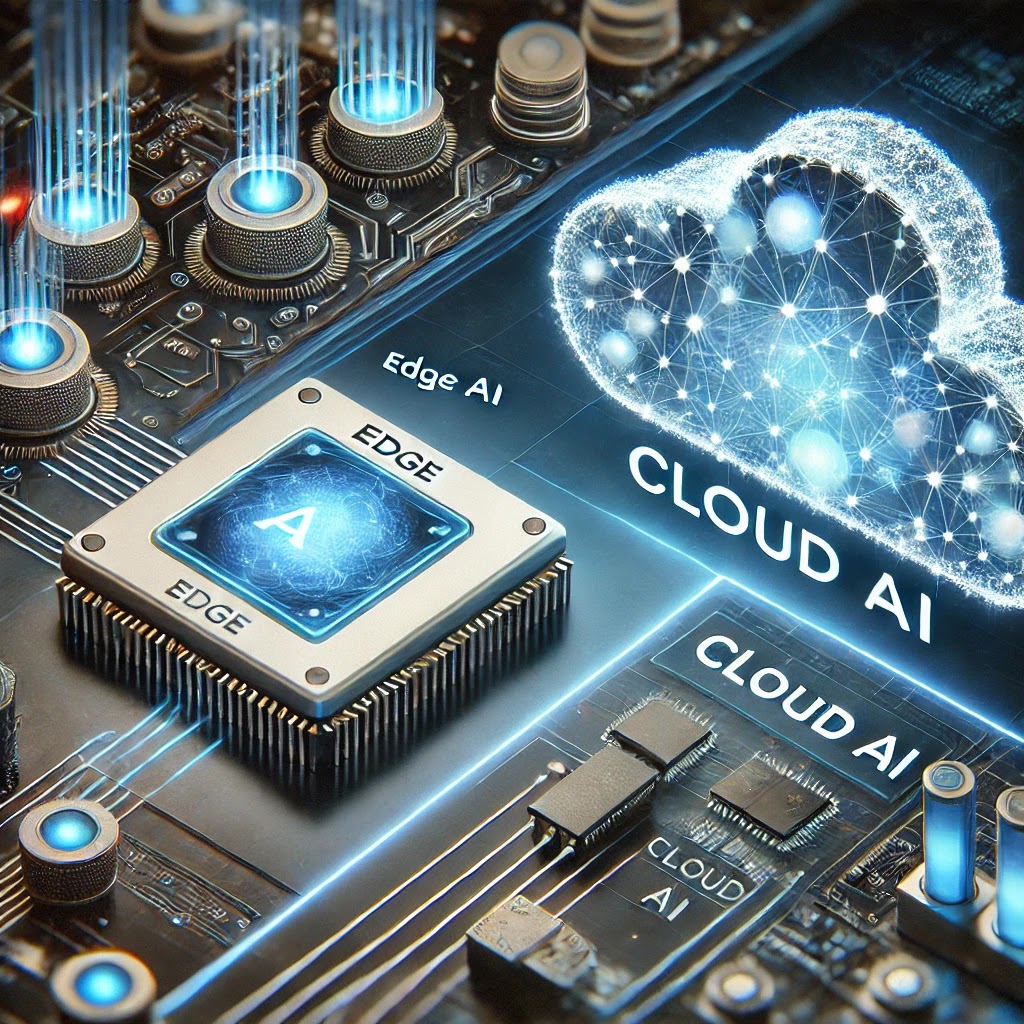
As Artificial Intelligence (AI) continues to evolve, two dominant paradigms have emerged: Edge AI and Cloud AI. Each has distinct advantages and use cases, but which one will shape the future? In this blog, we explore the key differences, benefits, and real-world applications of Edge AI and Cloud AI. 🔍
🌐 What is Cloud AI?
Cloud AI refers to AI models and processing tasks that run on remote cloud servers. It relies on high-powered data centers to handle complex computations, making it ideal for large-scale applications.
🛠️ Key Features of Cloud AI:
☁️ Scalability – Can handle vast amounts of data.
💾 High Storage – Stores and processes extensive datasets.
🔧 Centralized Processing – Requires an internet connection for computations.
🛠️ Advanced AI Models – Supports deep learning and big data analytics.
Example: Google Assistant and Amazon Alexa use Cloud AI to process voice commands and deliver responses.
🏎️ What is Edge AI?
Edge AI processes data locally on devices rather than relying on cloud-based servers. It enables real-time decision-making with minimal latency, making it perfect for applications requiring instant responses.
🛠️ Key Features of Edge AI:
⚡ Low Latency – Processes data instantly on the device.
📡 Reduced Cloud Dependency – Works offline without continuous internet.
🔋 Energy Efficient – Consumes less power than cloud computing.
🔒 Enhanced Security – Keeps sensitive data on local devices.
Example: Self-driving cars use Edge AI to process sensor data and make split-second decisions.
⚖️ Edge AI vs. Cloud AI: Key Differences
| Feature | Cloud AI | Edge AI |
|---|---|---|
| Processing | Centralized (Cloud Servers) | Decentralized (On-Device) |
| Latency | Higher (Dependent on Internet) | Ultra-Low (Real-Time Processing) |
| Connectivity | Requires Internet | Works Offline |
| Security | Data stored in cloud | Local data processing (More Secure) |
| Power Usage | High energy consumption | More energy-efficient |
🌍 Real-World Applications
🏥 Healthcare: Cloud AI analyzes medical images, while Edge AI enables real-time patient monitoring via wearable devices.
🚗 Automotive: Cloud AI supports navigation systems, while Edge AI ensures instant object detection in autonomous vehicles.
🏭 Manufacturing: Cloud AI optimizes production lines, while Edge AI monitors equipment for predictive maintenance.
📱 Smart Devices: Cloud AI powers virtual assistants, while Edge AI improves mobile AI capabilities.
🔮 The Future of AI: Cloud, Edge, or Both?
While Edge AI is gaining momentum due to its real-time capabilities and enhanced privacy, Cloud AI remains indispensable for large-scale data processing. The future likely lies in a hybrid AI approach, where both Edge and Cloud AI work together to deliver seamless, intelligent solutions. 🌟
💬 What’s Your Take?
👉 Do you think Edge AI will surpass Cloud AI, or will they coexist? Let us know in the comments! 💡
Comments
Post a Comment